The Paradigm Shift: From Supervised Imitation to Deliberative Search#
For the past five years, the dominant paradigm across large language models has been anchored in the scaling laws of pre-training and supervised fine-tuning (SFT). We scaled transformer parameter counts ($N$), pumped petabytes of pre-training tokens ($D$), and fine-tuned models on curated pairs of human demonstrations. But across enterprise engineering environments—specifically in distributed workflows, complex mathematical verification, and autonomous agent orchestration—SFT has slammed into a hard ceiling.
SFT models are fundamentally probabilistic imitators. When tasked with a 30-step cloud infrastructure migration or a distributed consensus verification, standard autoregressive models suffer from exponential error compounding. If each inference step has a 97% success rate, a 25-step execution chain yields an overall task completion probability of just $(0.97)^{25} \approx 46.7\%$.
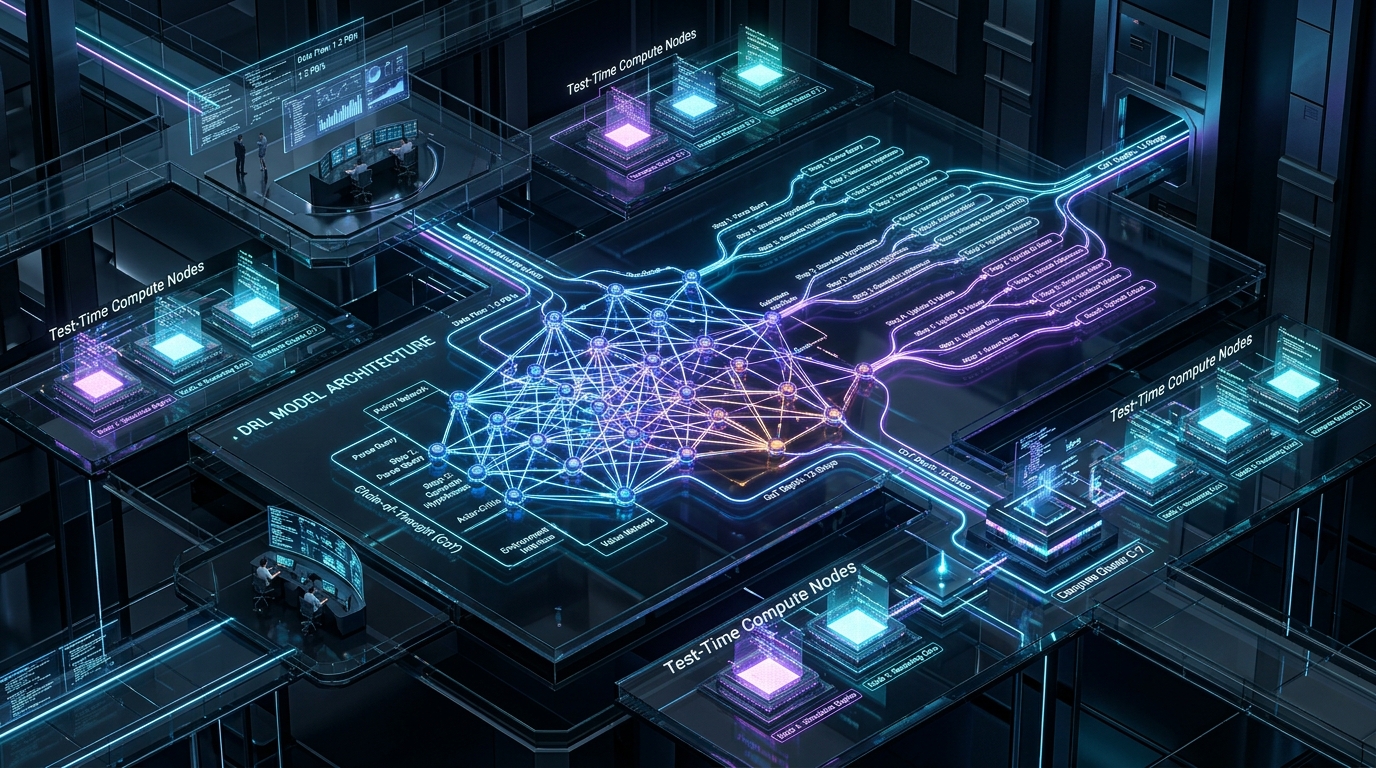
The release of DeepSeek-R1 and its foundational precursor DeepSeek-R1-Zero marks a historic architectural pivot. By shifting the computational burden from brute-force pre-training to Test-Time Compute ($t \gg 1$) driven by pure Reinforcement Learning (RL), DeepSeek has demonstrated that models can autonomously discover structured reasoning, self-reflection, and programmatic backtracking without human CoT annotations.
---
The Breakdown: Why SFT Failed and How GRPO Rewrote the Rules#
1. The Supervised Fine-Tuning Capability Wall#
Traditional alignment pipelines rely on Reinforcement Learning from Human Feedback (RLHF) built atop Proximal Policy Optimization (PPO). This approach suffers from two severe bottlenecks in production agentic systems:
2. Group Relative Policy Optimization (GRPO)#
Standard PPO requires training both an Actor model and a Critic model (which is typically of equivalent parameter scale to the actor). Storing both models, along with reference policies and reward models in GPU memory, creates extreme memory overhead during distributed training on 671B Mixture-of-Experts (MoE) architectures.
DeepSeek bypassed the critic model entirely using Group Relative Policy Optimization (GRPO). Instead of using a learned value function to estimate the baseline, GRPO samples a group of candidate outputs $\{o_1, o_2, \dots, o_G\}$ for each input query $q$ from the old policy $\pi_{\theta_{\text{old}}}$, and computes the advantage using the relative reward within that group:
$$
A_i = \frac{r_i - \text{mean}(\{r_1, r_2, \dots, r_G\})}{\text{std}(\{r_1, r_2, \dots, r_G\})}
$$
The objective function maximized by GRPO is formulated as:
$$
\mathcal{J}_{\text{GRPO}}(\theta) = \mathbb{E}_{q \sim P(Q), \{o_i\}_{i=1}^G \sim \pi_{\theta_{\text{old}}}(O|q)} \left[ \frac{1}{G} \sum_{i=1}^G \min \left( \frac{\pi_\theta(o_i|q)}{\pi_{\theta_{\text{old}}}(o_i|q)} A_i, \text{clip}\left( \frac{\pi_\theta(o_i|q)}{\pi_{\theta_{\text{old}}}(o_i|q)}, 1-\epsilon, 1+\epsilon \right) A_i \right) - \beta D_{\text{KL}}(\pi_\theta \parallel \pi_{\text{ref}}) \right]
$$
+-------------------------------------------------------------------------+
|                    GRPO Training Dynamics Pipeline                      |
+-------------------------------------------------------------------------+

       Input Query (q)
              |
              v
    +-------------------+
    |   Old Policy      |
    | (pi_theta_old)    |
    +-------------------+
              |
      Generate Group of G Samples
              |
      +-------+-------+-------+
      |               |       |
      v               v       v
   Sample o_1      Sample o_2 ... Sample o_G
      |               |       |
      v               v       v
   [ Rule-Based Accuracy & Format Reward Verifiers ]
      |               |       |
     r_1             r_2     r_G
      |               |       |
      +-------+-------+-------+
              |
              v
   Compute Group Mean & Std Dev
              |
              v
   Relative Advantage A_i = (r_i - mean) / std
              |
              v
   Actor Policy Gradient Step (Zero Critic Model Memory Overhead)
By leveraging deterministic rule-based rewards (e.g., mathematical equality compilers, unit test execution, and strict XML formatting checks), the model is optimized purely against verifiable ground truth rather than a subjective human rating.
3. The Emergence of the "Aha Moment"#
In DeepSeek-R1-Zero, reinforcement learning was unleashed directly onto the raw base model (DeepSeek-V3-Base) without a single supervised warm-up sample. Within thousands of RL iterations, the training logs revealed an extraordinary emergent capability: spontaneous internal reflection and backtracking.
When confronted with an ambiguous constraint, the model generated intermediate reasoning tokens, detected an algebraic inconsistency in its own trace, explicitly stated *"Wait, let me double-check this step... No, that formula doesn't satisfy condition B"*, discarded the dead-end branch, and re-routed its search trajectory. This confirmed that Chain-of-Thought is not a conversational format to be taught; it is an optimal search strategy discovered by reinforcement learning under compute incentives.
To address R1-Zero's readability quirks (language mixing and long-windedness), the production DeepSeek-R1 pipeline introduced a four-stage training regimen:
---
System Architecture: Test-Time Compute Scaling & Agentic Decomposition#
Test-Time Compute Scaling Laws#
During pre-training, compute is fixed once weights are frozen. In production, however, difficulty varies dramatically: summarizing an email requires minimal compute, while debugging a distributed deadlock across 8 Kafka consumer groups requires deep algorithmic exploration.
Reasoning models operationalize Test-Time Compute ($t \gg 1$). By allowing the model to dynamically allocate internal reasoning tokens before committing to an external action, we replace brittle single-pass execution with an inference-time search:
$$
P(\text{Success} \mid q) \propto f(\text{FLOPs}_{\text{pretrain}}, \text{Tokens}_{\text{reasoning}})
$$
In high-stakes enterprise systems, allocating $4,000$ reasoning tokens at $\$0.002$ per execution is three orders of magnitude cheaper than recovering from a silent database migration failure.
                     +---------------------------------------+
                     |     Complex Enterprise Task Request    |
                     +---------------------------------------+
                                         |
                                         v
                     +---------------------------------------+
                     |      DELIBERATIVE PLANNER             |
                     |         (DeepSeek-R1)                 |
                     |  - Test-Time Extended CoT             |
                     |  - State Invariant Decomposition      |
                     |  - Self-Verification & Backtracking   |
                     +---------------------------------------+
                                         |
                      Emits Verified DAG Execution Contract
                                         |
                                         v
                     +---------------------------------------+
                     |     SUPERVISORY ROUTER / GRAPH        |
                     |  (Deterministic State Machine Engine) |
                     +---------------------------------------+
                                    /    |    \
            +----------------------+     |     +----------------------+
            v                            v                            v
  +--------------------+       +--------------------+       +--------------------+
  |  Worker Node A     |       |  Worker Node B     |       |  Worker Node C     |
  | (Distilled Qwen)   |       | (Claude 3.5 Haiku) |       | (Native Microsvc)  |
  | DB Schema Query    |       | API Spec Validator |       | Kafka Producer     |
  +--------------------+       +--------------------+       +--------------------+
            \                            |                            /
             +---------------------------+---------------------------+
                                         |
                                         v
                     +---------------------------------------+
                     |      RUNTIME AUDIT & VERIFIER         |
                     | Checks execution invariants & returns |
                     | telemetry back to R1 if anom detected |
                     +---------------------------------------+
The Deliberative Planner vs. Reactive Worker Architecture#
Deploying a 671B reasoning model directly to interact with interactive chat interfaces or low-latency webhooks creates unacceptable latency (time-to-first-token often exceeds 6–12 seconds).
Instead, the battle-tested enterprise architecture uses Hierarchical Deliberative Planning:
<think> trajectory, validates environmental invariants, and outputs a strictly typed directed acyclic graph (DAG) of micro-tasks.---
Production Integration & Code: Orchestrating DeepSeek-R1 in Enterprise Pipelines#
When integrating DeepSeek-R1 into enterprise agent pipelines, software engineers must address three non-negotiables:
<think>...</think> internal trace from the actionable payload to prevent telemetry leakage into customer-facing interfaces.Here is a complete, production-grade TypeScript orchestration service for enterprise agent systems:
import { OpenAI } from 'openai';
import { z } from 'zod';

// 1. Strict Contract for the Final Actionable Execution Plan
export const AgentExecutionPlanSchema = z.object({
  planId: z.string().uuid(),
  targetGoal: z.string(),
  invariantsValidated: z.array(z.string()),
  steps: z.array(z.object({
    stepNumber: z.number(),
    actionType: z.enum(['DATABASE_MIGRATION', 'API_INVOCATION', 'EVENT_PUBLISH', 'MANUAL_APPROVAL']),
    payload: z.record(z.any()),
    rollbackCondition: z.string(),
    timeoutMs: z.number().default(5000),
  })),
  riskAssessment: z.enum(['LOW', 'MEDIUM', 'HIGH', 'CRITICAL']),
  estimatedDowntimeSeconds: z.number(),
});

export type AgentExecutionPlan = z.infer<typeof AgentExecutionPlanSchema>;

export interface DeliberativeAgentResponse {
  reasoningTrace: string;
  executionPlan: AgentExecutionPlan;
  reasoningTokensConsumed: number;
  executionWallTimeMs: number;
}

export class EnterpriseReasoningOrchestrator {
  private client: OpenAI;
  private modelName: string;

  constructor(apiKey: string, baseURL = 'https://api.deepseek.com', modelName = 'deepseek-reasoner') {
    this.client = new OpenAI({ apiKey, baseURL });
    this.modelName = modelName;
  }

  public async orchestrateComplexTask(
    systemContext: string,
    userIntent: string,
    timeoutMs = 60000
  ): Promise<DeliberativeAgentResponse> {
    const startTime = Date.now();
    const controller = new AbortController();
    const timeout = setTimeout(() => controller.abort(), timeoutMs);

    const prompt = `
SYSTEM CONTEXT:
${systemContext}

OBJECTIVE:
${userIntent}

INSTRUCTIONS:
1. Conduct an exhaustive step-by-step reasoning analysis in your internal thoughts.
2. Identify potential failure modes, race conditions, and rollback triggers.
3. Verify all constraints.
4. Output your final response strictly as a JSON object matching this schema:
{
  "planId": "uuid",
  "targetGoal": "string",
  "invariantsValidated": ["string"],
  "steps": [
    {
      "stepNumber": 1,
      "actionType": "DATABASE_MIGRATION" | "API_INVOCATION" | "EVENT_PUBLISH" | "MANUAL_APPROVAL",
      "payload": {},
      "rollbackCondition": "string",
      "timeoutMs": 5000
    }
  ],
  "riskAssessment": "LOW" | "MEDIUM" | "HIGH" | "CRITICAL",
  "estimatedDowntimeSeconds": 0
}
`;

    try {
      const response = await this.client.chat.completions.create({
        model: this.modelName,
        messages: [
          { role: 'system', content: 'You are an enterprise deliberative reasoning planner. You plan multi-agent workflows with zero margin for error.' },
          { role: 'user', content: prompt }
        ],
        temperature: 0.1, // Low temperature for high deterministic grounding
        max_tokens: 8192,
      }, { signal: controller.signal });

      clearTimeout(timeout);

      const message = response.choices[0]?.message;
      if (!message) {
        throw new Error('Null response received from reasoning orchestrator.');
      }

      // Extract DeepSeek-R1 reasoning thought process
      // DeepSeek's API surfaces reasoning in reasoning_content field
      const reasoningTrace = (message as any).reasoning_content || this.extractThinkTag(message.content || '');
      const rawContent = (message.content || '').replace(/<think>[\s\S]*?<\/think>/gi, '').trim();

      // Extract JSON cleanly
      const jsonMatch = rawContent.match(/\{[\s\S]*\}/);
      if (!jsonMatch) {
        throw new Error('Reasoning model failed to output a structured JSON plan.');
      }

      const parsedJson = JSON.parse(jsonMatch[0]);
      const validatedPlan = AgentExecutionPlanSchema.parse(parsedJson);

      return {
        reasoningTrace,
        executionPlan: validatedPlan,
        reasoningTokensConsumed: response.usage?.completion_tokens || 0,
        executionWallTimeMs: Date.now() - startTime,
      };
    } catch (err: any) {
      clearTimeout(timeout);
      if (err.name === 'AbortError') {
        throw new Error(`Reasoning orchestrator exceeded SLA timeout of ${timeoutMs}ms.`);
      }
      throw new Error(`Enterprise reasoning planning failed: ${err.message}`);
    }
  }

  private extractThinkTag(content: string): string {
    const match = content.match(/<think>([\s\S]*?)<\/think>/i);
    return match ? match[1].trim() : '';
  }
}
---
Enterprise Performance & Benchmark Matrix#
To understand why DeepSeek-R1 has permanently disrupted enterprise AI roadmaps, we must look beyond marketing claims and examine standardized reasoning and mathematics benchmarks alongside operational token economics.
| Benchmark / Metric | OpenAI o1 (High) | DeepSeek-R1 (671B MoE) | Claude 3.5 Sonnet | GPT-4o (Omni) |
|---|---|---|---|---|
| AIME 2024 (Pass@1) | 79.2% | 79.8% | 39.2% | 13.4% |
| MATH-500 | 96.4% | 97.3% | 78.3% | 74.6% |
| Codeforces Percentile | 96.6% | 96.3% | 77.2% | 60.8% |
| MMLU (Pass@1) | 91.8% | 90.8% | 88.3% | 88.7% |
| Cost per 1M Input Tokens | $15.00 | $0.55 (27x cheaper) | $3.00 | $2.50 |
| Cost per 1M Output Tokens | $60.00 | $2.19 (27x cheaper) | $15.00 | $10.00 |
| Weights Accessibility | Proprietary Black-Box | Fully Open Weights (MIT) | Proprietary API | Proprietary API |
| Self-Verification & Backtrack | Native Test-Time | Native Test-Time (RL) | None (Linear Autoregressive) | None (Linear Autoregressive) |
| On-Premise / Sovereign Cloud | Impossible | Fully Deployable (vLLM/SGLang) | Impossible | Impossible |
The Economic Realities of Test-Time Compute#
Prior to DeepSeek-R1, running deep deliberative reasoning across enterprise workloads was cost-prohibitive for high-throughput production queues. Running $100,000$ complex agentic verifications monthly on OpenAI o1 would generate output token bills exceeding $18,000 to $30,000.
With DeepSeek-R1's pricing ($0.55 / 1M input, $2.19 / 1M output) and its MIT-licensed open weights deployable onto private on-premise H100/H200 clusters, the cost of deliberative intelligence has fallen by ~96% overnight. Enterprise teams can now afford to let models spend thousands of test-time reasoning tokens verifying compliance, validating distributed states, and auditing API schemas.
---
Centralogic Production Lessons: Engineering Reasoning Agents at Scale#
In our engineering initiatives at Centralogic, integrating deliberative reasoning models into enterprise automation, telemetry verification, and multi-agent copilots has revealed critical architectural lessons:
1. Invariant-First Prompt Architecture#
Standard prompts asking the model to "think step-by-step" are insufficient for enterprise workflows. You must explicitly instruct the reasoning model on system invariants (e.g., *"Database partition keys cannot be mutated during online sync"*, *"API idempotency tokens must survive retry cycles"*). DeepSeek-R1's reinforcement learning foundation actively latches onto negative constraints and runs rigorous internal test simulations against them in <think> before emitting code.
2. Isolate Thought Traces from Consumer UIs#
Reasoning traces can span 2,000 to 8,000 tokens of internal reflection, false starts, and self-corrections. Never stream the raw `<think>` buffer directly to end users in line-of-business applications. Instead:
<think> logs into your telemetry collector (e.g., OpenTelemetry, Datadog, or Seq) as audit metadata. When a production action triggers an alert, engineers can replay the model's exact internal rationale.3. Prompt Prefix Caching is Mandatory#
Because deliberative agents require comprehensive context (system schemas, OpenAPI specs, invariant rules), your input prompts frequently exceed 10,000 tokens. Using modern inference engines with KV cache reuse (such as vLLM's Chunked Prefill or SGLang's RadixAttention) drops the prompt ingestion latency from seconds to milliseconds, dramatically improving agent responsiveness.
4. Guardrailing the CoT Infinite Loop#
In rare edge cases with paradoxical constraints, reasoning models can fall into self-questioning loops, continuously second-guessing their assumptions until they hit max token limits. Production wrappers must enforce strict token ceilings and latency budgets (AbortController in Node/TypeScript, CancellationTokenSource with timeout in .NET C#) to fail gracefully to a human fallback.
---
Architectural Maxim#
DeepSeek-R1 has permanently shifted the horizon of artificial intelligence. By proving that pure reinforcement learning unlocks emergent human-level reasoning at open-source efficiency, it empowers software engineers to build autonomous agents that do not merely guess the next token—they deliberately verify the next action.