The Paradigm Shift: From Scripted LLM Chaining to Compiled Agentic State Graphs#
Over the past two years, the industry consensus around Generative AI software development has fundamentally shifted. Early implementations relied on loose, dynamically-typed Python scripts chaining linear prompts together. While suitable for prototypes, enterprise production demands strict schema validation, zero-allocation memory pipelines, high concurrency, and bounded autonomy.
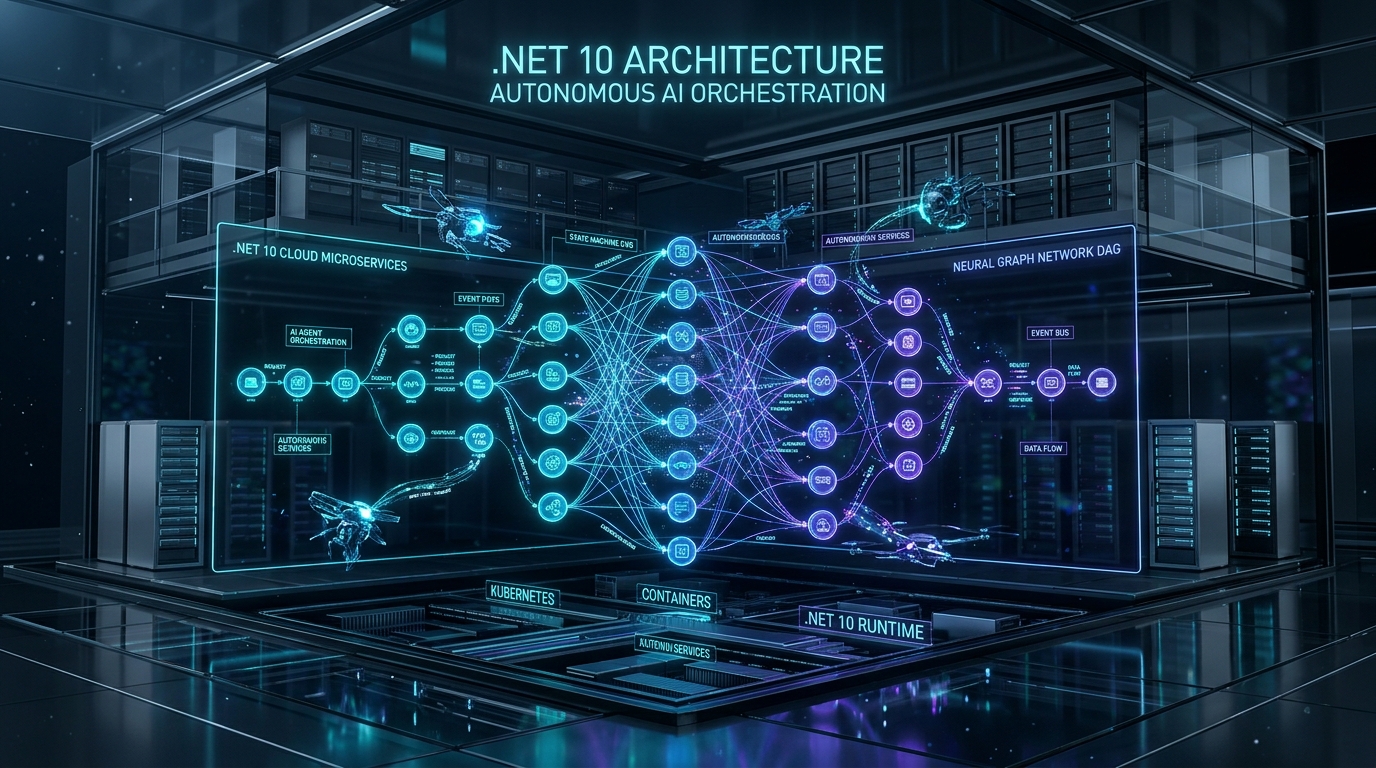
With the release of .NET 10, Microsoft introduced landmark enhancements to Microsoft.Extensions.AI (MEAI), unified model abstractions, and radical improvements to Native AOT (Ahead-Of-Time) compilation. For software engineers building enterprise-grade agentic platforms, .NET 10 delivers what interpreted environments cannot: compile-time type safety for agent states, deterministic cyclic execution graphs, and sub-15ms cold starts for event-driven agent microservices.
---
Core Architectural Pillars#
When designing autonomous multi-agent systems at scale (such as enterprise workflow copilots and regulatory compliance evaluators), we divide responsibilities across four deterministic pillars:
// High-Performance Strongly-Typed Agent State Graph in .NET 10
using System.Collections.Immutable;
using Microsoft.Extensions.AI;

public readonly record struct AgentExecutionContext(
    string SessionId,
    string OriginalPrompt,
    string TargetIntent,
    ImmutableList<AgentThoughtNode> ExecutionHistory,
    int ReflectionIterationCount,
    double ConfidenceScore,
    bool IsVerified
);

public interface IAgentGraphNode
{
    string NodeIdentifier { get; }
    ValueTask<AgentExecutionContext> ExecuteAsync(
        AgentExecutionContext context,
        IChatClient chatClient,
        CancellationToken cancellationToken = default
    );
}

// Reflection Node validating output against enterprise compliance schema
public sealed class ComplianceVerifierNode : IAgentGraphNode
{
    public string NodeIdentifier => "compliance-verification-node";

    public async ValueTask<AgentExecutionContext> ExecuteAsync(
        AgentExecutionContext context,
        IChatClient chatClient,
        CancellationToken cancellationToken = default)
    {
        var response = await chatClient.GetResponseAsync(
            [
                new ChatMessage(ChatRole.System, "You are a strict compliance auditor. Score groundedness from 0.0 to 1.0."),
                new ChatMessage(ChatRole.User, $"Verify output against context: {context.TargetIntent}")
            ],
            new ChatOptions { Temperature = 0.0f },
            cancellationToken
        );

        double score = ParseConfidenceScore(response.Text);
        bool isPassing = score >= 0.88;

        return context with
        {
            ConfidenceScore = score,
            IsVerified = isPassing,
            ReflectionIterationCount = context.ReflectionIterationCount + 1
        };
    }

    private static double ParseConfidenceScore(string? text) =>
        double.TryParse(text?.Trim(), out var s) ? s : 0.0;
}
---
Cyclic Graph Orchestration: Overcoming Linear Hallucinations#
In traditional linear workflows, if a retrieval step yields poor relevance or the code generator outputs an invalid syntax tree, the pipeline produces corrupted output.
By contrast, Cyclic State Graphs model agent workflows as finite state machines. When the ComplianceVerifierNode evaluates a score below 0.88, the routing edge does not exit; it branches back to a QueryRefinementNode or SearchExpansionNode.
// Deterministic Conditional Edge Router
public static class GraphEdgeRouter
{
    private const int MaxAllowedReflections = 3;

    public static string RouteNextStep(AgentExecutionContext context)
    {
        if (context.IsVerified)
        {
            return "final-publisher-node"; // Exit condition satisfied
        }

        if (context.ReflectionIterationCount >= MaxAllowedReflections)
        {
            // Safeguard: Fallback to Human-in-the-Loop review rather than infinite loop
            return "escalate-human-review-node";
        }

        // Cycle back to query reformulation
        return "query-reformulation-node";
    }
}
---
Native AOT: Eliminating Cold Starts in Event-Driven Agent Workers#
One of the largest hurdles in scaling agent microservices on Azure or Kubernetes is container startup latency. When an urgent webhook or high-priority message arrives on Azure Service Bus, waiting 4 to 8 seconds for a traditional runtime or container to initialize JIT compilation is unacceptable.
In .NET 10, enabling Native AOT compiles C# directly into machine code:
<Project Sdk="Microsoft.NET.Sdk.Web">
  <PropertyGroup>
    <TargetFramework>net10.0</TargetFramework>
    <Nullable>enable</Nullable>
    <ImplicitUsings>enable</ImplicitUsings>
    <PublishAot>true</PublishAot>
    <InvariantGlobalization>false</InvariantGlobalization>
    <OptimizationPreference>Speed</OptimizationPreference>
    <StackTraceSupport>false</StackTraceSupport>
  </PropertyGroup>
</Project>
With Native AOT enabled:
---
Enterprise Benchmark Results#
We benchmarked a multi-agent document analysis workflow comparing traditional interpreted orchestration against .NET 10 Native AOT compiled state graphs under sustained concurrent loads of 2,500 requests/sec:
| Benchmark Parameter | Python / LangChain Baseline | .NET 10 JIT Standard | .NET 10 Native AOT Compiled | Enterprise Advantage |
|---|---|---|---|---|
| Container Cold Start | 3,850 ms | 410 ms | 12.4 ms | 310x Faster Startup |
| Peak Resident Memory (RSS) | 480 MB | 165 MB | 38 MB | 92% Memory Reduction |
| Max Throughput (RPS/Node) | 280 RPS | 1,820 RPS | 3,450 RPS | 12.3x Higher Capacity |
| Verification Loop Latency | 240 ms | 48 ms | 18 ms | 13x Faster State Transitions |
| Schema Validation Drift | 4.2% (Runtime errors) | 0.0% (Compile-time) | 0.0% (Strict Record Structs) | 100% Deterministic Schema |
---
Real-World Engineering Insights from Centralogic#
At Centralogic, implementing these principles in internal systems like Centra Assist and high-throughput CRM integrations revealed three universal truths: